
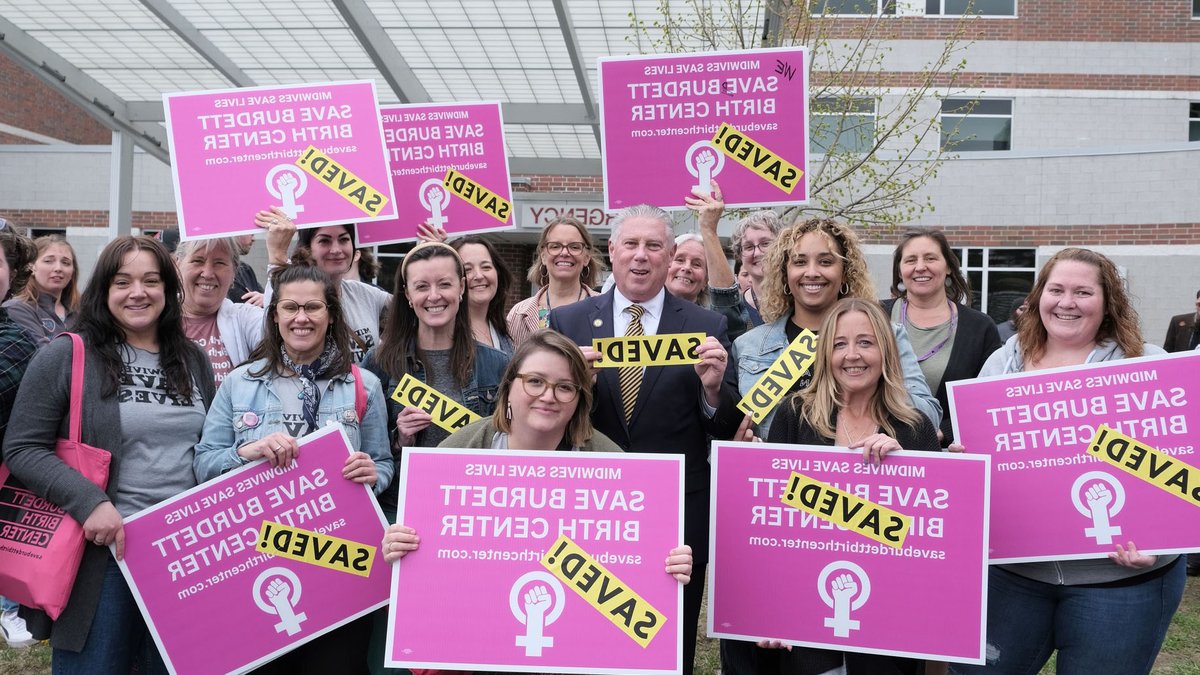
Troy, N.Y. — When a local newspaper broke the news that Samaritan Hospital’s Burdett Birth Center would close, Starletta Washington’s reaction was immediate: “It was devastating.” The city’s last birthing center, where Washington gave birth to her own children, was set to shut down after Trinity Health, the Catholic hospital system that owns it, announced the decision in 2022. Babies had been delivered at Samaritan Hospital since the city’s factories produced most of America’s shirt collars a century ago, making the birth center a long-standing community institution. Without Burdett, families would have to drive up to 30 minutes to Albany for deliveries—or risk giving birth in less ideal circumstances.
Washington, who heads the Troy YWCA, wasn’t alone in her frustration. The closure threatened to leave a 20,000-person city without a local option for childbirth, forcing patients to rely on emergency services or travel. “Nobody else was going to be born in the city of Troy unless they were born on a city bus, in the back of a cab, or, disgustingly, on the side of the street?” Washington said. “Blew my mind.” Activists later highlighted that the closure would disproportionately affect low-income families, many of whom lacked reliable transportation to Albany.
Grassroots campaign forces hospital to reverse course
The plan fit a broader trend: Since 2010, hundreds of U.S. maternity units have closed as hospitals consolidate under larger systems. But in Troy, a grassroots campaign—backed by politicians, midwives, and even the local Catholic diocese—forced Trinity to reverse course nearly a year later. The birth center remains open, a rare victory in a decade of declining rural and urban obstetric care.
The Burdett Birth Center had long been a model for low-intervention care. Midwives and doulas worked alongside OB-GYNs, and only 24% of births there were by C-section, below the 33% statewide average, according to 2025 hospital data. Patient safety advocates have long pushed to reduce unnecessary surgical deliveries, which can increase complications. Preterm births and low birth weights were also lower than regional averages. For Lidia Zambrano-Madera, a Troy resident who delivered both her children at Burdett with the help of a midwife, the center’s proximity and personalized care were non-negotiable. For Zambrano-Madera, who recently opened a children’s play center in Troy, Burdett offered another advantage: It was just five minutes from home.
Yet Trinity Health, a multibillion-dollar Michigan-based hospital system, argued the center was unprofitable. Executives cited financial strain. “We’ve been frantic about trying not to cut the care at the bedside,” said Steven Hanks, a physician who oversees Trinity hospitals in New York and New England. “But, you know, you get to a point where you can only consolidate so much. You can only spread people so thin, and then you have to start taking harder looks at your actual services.” The announcement caught local leaders off guard.
Related Post: How Louisiana’s New Surgeon General Plans to Reshape Public Health Policy
Bipartisan outrage unites Troy’s community and church
Within days, midwives, doulas, and politicians organized a rally at the YWCA. Activists handed out pink “Save Burdett” signs at farmers markets and conducted a survey revealing that 25% of Troy residents lacked reliable car access, making the trip to Albany difficult. The campaign tapped into widespread anger over Trinity’s corporate approach, a system that, as one activist put it, “didn’t appreciate how important the center was to the Troy community.”
What made the effort unique was its bipartisan unity. Carmella Mantello, Troy’s Republican mayor at the time, called the closure “a slap in the face to the community.” Even the Catholic bishop opposed the shutdown, arguing it contradicted the church’s values. “Nothing is more central to the Catholic healthcare mission than supporting life and all those who bring it into the world,” Bishop Edward Scharfenberger said after Trinity announced the closure plan. The campaign united even Planned Parenthood and the diocese, reflecting broad consensus on the issue.
Trinity’s plans, news of which broke in a local newspaper, came without warning, surprising the obstetrical staff and community leaders. They set off a firestorm. Ultimately, powerful state officials, including New York Attorney General Letitia James, joined the fight to save the birthing center, launching an investigation into the proposed closure and hosting a daylong hearing in Troy. State Assembly member John T. McDonald III, a Democrat who represents Troy, worked with Republican elected officials, including the county executive and the state senator representing Troy, to secure funding to help keep Burdett open.
How local resistance reshapes healthcare consolidation battles
The victory reflects a shifting dynamic in healthcare advocacy. Communities increasingly push back against hospital consolidations, questioning promises of “efficiencies” and “better care” when closures remove local access. Lois Uttley, a healthcare researcher, noted that such systems often break their commitments: “The executives will tell you joining a big system will improve quality, but what I’ve seen is those promises are broken.” The Troy campaign demonstrated how grassroots pressure, bipartisan cooperation, and legal intervention could challenge corporate healthcare decisions.
For John T. McDonald III, the state assemblyman who helped broker the funding, the lesson was simpler: “If we take down our swords and put out our arms, maybe we can get something done.” In Troy, that meant saving a birth center, and, for now, keeping babies born where they belong: in a hospital, not on a bus.


